The Hum Of Your Rhythm
Tues–Fri, 1–7 p.m. / Sat, 1–4 p.m.
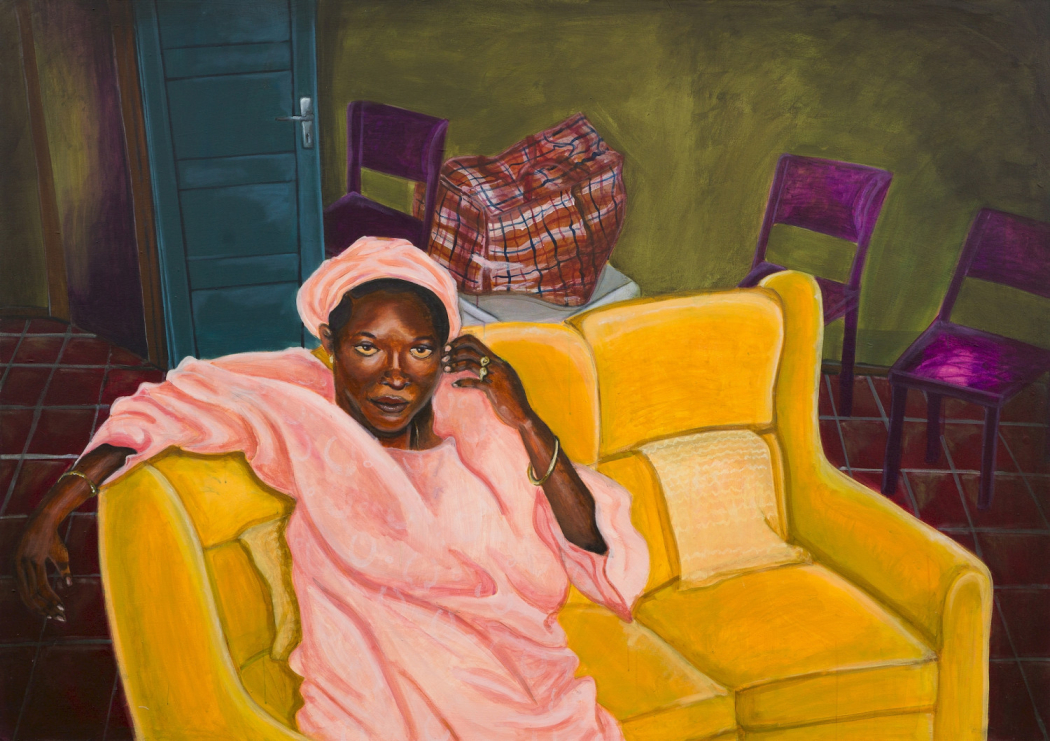
In her large-scale, colourful paintings, Aduni Ogunsan explores figures from her personal environment – family members, friends and groups from her everyday life. The starting point for this is an exploration of a family photo album from a time before Ogunsan was born. It shows people whom she cannot identify with certainty, but with whom she feels a personal connection and whose stories she seeks to trace. In her search for possible roots, the artist’s photographic source material offers a space of possibility for the articulation of her own story.
Other works depict Black and queer intersections. Here, the artist sees herself as a contemporary witness. It is important to Ogunsan to respond to the political shift to the right and to give visibility to queer Black voices. The works capture everyday moments within the community and highlight their visibility.
The painted everyday scenes appear authentic, not staged – familiar and alien at the same time. The artist’s personal interest and her connection to those depicted are shared with the audience, who are naturally integrated into the group of larger-than-life figures.
“The Hum Of Your Rhythm” alludes to this sense of community, which can be compared to a non-verbal, low-frequency resonance experienced as a group, the vibrations of which are transmitted to all the bodies involved.
Aduni Ogunsan is a painter with a special relationship with textiles as a medium. On the one hand, it serves as a picture carrier – the canvas substrate for her acrylic paintings, a textile extension of the pictorial space, and the basis for her monochrome velvet embossings. On the other hand, the patterned garments worn by the sitters play a role in shaping their identity. Their clothing is no coincidence. It conveys information about the wearer, about self-presentation, about cultural appropriation and reinvention.
The textiles that Aduni Ogunsan uses are not neutral materials. She does not regard fabrics as mere decoration, but as carriers of memory, as evidence of global interconnections, as archives that can be reinterpreted and rewritten. Velvet has its own commercial history – it was traded for centuries along global routes, from Asia to Europe, from Europe to Africa. And the patterns she selects tell their own stories: of the introduction of Dutch wax print to West Africa, of batik techniques, and of the surprising fact that this fabric, now regarded as so typically African, was neither produced nor designed in Africa.